
Acoustic guitars form several notable subcategories within the acoustic guitar group: classical and flamenco guitars; steel-string guitars, which include the flat-topped, or “folk”, guitar; twelve-string guitars; and the arched-top guitar. The acoustic guitar group also includes unamplified guitars designed to play in different registers, such as the acoustic bass guitar, which has a similar tuning to that of the electric bass guitar.
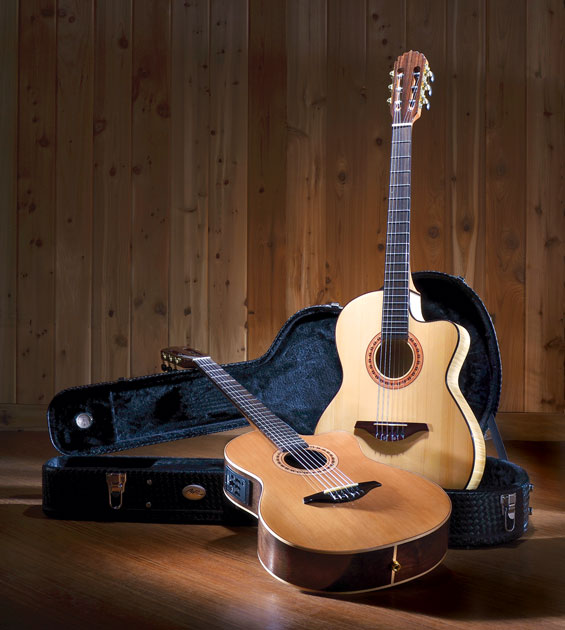
lassical guitars, also known as “Spanish” guitars,[14] are typically strung with nylon strings, plucked with the fingers, played in a seated position and are used to play a diversity of musical styles including classical music.


The classical guitar’s wide, flat neck allows the musician to play scales, arpeggios, and certain chord forms more easily and with less adjacent string interference than on other styles of guitar. Flamenco guitars are very similar in construction, but they are associated with a more percussive tone. In Portugal, the same instrument is often used with steel strings particularly in its role within fado music. The guitar is called viola, or violão in Brazil, where it is often used with an extra seventh string by choro musicians to provide extra bass support.
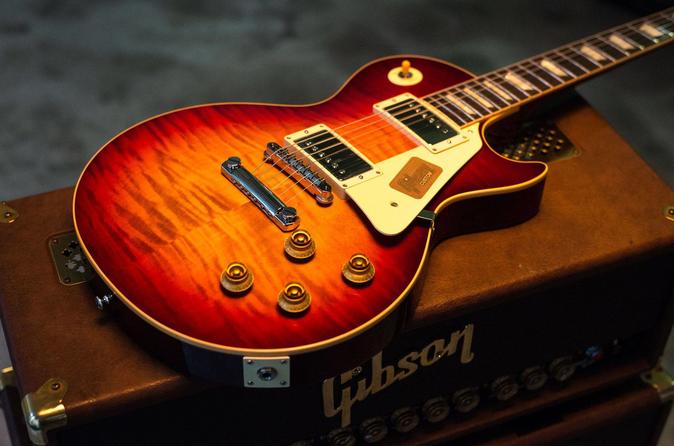
Electric guitars can have solid, semi-hollow, or hollow bodies; solid bodies produce little sound without amplification. Electromagnetic pickups, and sometimes piezoelectric pickups, convert the vibration of the steel strings into signals, which are fed to an amplifier through a patch cable or radio transmitter. The sound is frequently modified by other electronic devices (effects units) or the natural distortion of valves (vacuum tubes) or the pre-amp in the amplifier. There are two main types of magnetic pickups, single- and double-coil (or humbucker), each of which can be passive or active. The electric guitar is used extensively in jazz, blues, R & B, and rock and roll. The first successful magnetic pickup for a guitar was invented by George Beauchamp, and incorporated into the 1931 Ro-Pat-In (later Rickenbacker) “Frying Pan” lap steel; other manufacturers, notably Gibson, soon began to install pickups in archtop models. After World War II the completely solid-body electric was popularized by Gibson in collaboration with Les Paul, and independently by Leo Fender of Fender Music. The lower fretboard action (the height of the strings from the fingerboard), lighter (thinner) strings, and its electrical amplification lend the electric guitar to techniques less frequently used on acoustic guitars. These include tapping, extensive use of legato through pull-offs and hammer-ons (also known as slurs), pinch harmonics, volume swells, and use of a tremolo arm or effects pedals.
 PAGuitar